In my program of Fashion Design, I sometimes had to gain skills the by doing experiment since I didn't understood technical terms that would of been useful to me when I first started. I hope that by sharing this list, I can help a newbie.
A-line
noun
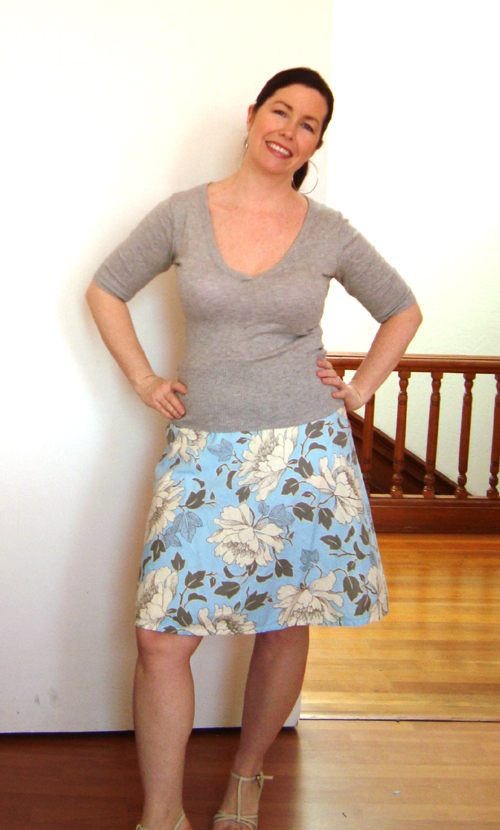
An A-line skirt is a skirt that is fitted at the hips and gradually widens towards the hem, giving the impression of the shape of a capital letter A. The term is also used to describe dresses and coats with a similar shape.The term was invented by Christian Dior in 1955 to describe the shape of his A-Line Spring Summer collection.
Example: As well as potential injury and legal proceedings from others the uniform we wear is thought to increase the incidence of back injury amongst staff as the A\-LINE dress worn shrinks once washed and is traditionally combined with a petersham belt, the narrow width of the skirt makes proper lifting techniques impossible placing midwives at greater risk of back injury (Pride, 1995).
fr: Ligne A
Appliqué
noun
The appliqué is a pattern that will be sewn onto a fabric.
Example: The appliqué is a fabric shape sewn in satin stitch (very tight zig-zag) on another fabric, it is a decorative element.
fr: Appliqué
Bias cut
adjective
Piece of a garment or fabric cut obliquely or diagonally across the grain.
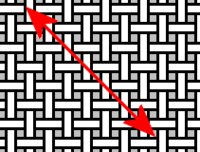
Example: Bias cut means to ‘be cut on the grain’. Rather than following the straight line of the weave, the bias cut places the pattern at a 45° angle on the woven fabric. At this angle, the ‘warp’ and ‘weft’ threads give the fabric more of an elastic ‘stretch.’
fr: coupe biaisée
Boiled wool
noun
Boiled wool is a type of fabric primarily used in creating berets, scarves, vests, cardigans, coats, and jackets. To create this fabric, knit wool or wool-blend fabrics are agitated with hot water in a process called fulling.
Example: And by boiling the wool it shrinks so when it's made into clothes it doesn't let the wind in or your heat out – making it warmer than regular wool.
fr: Laine bouillie
Cheongsam
noun
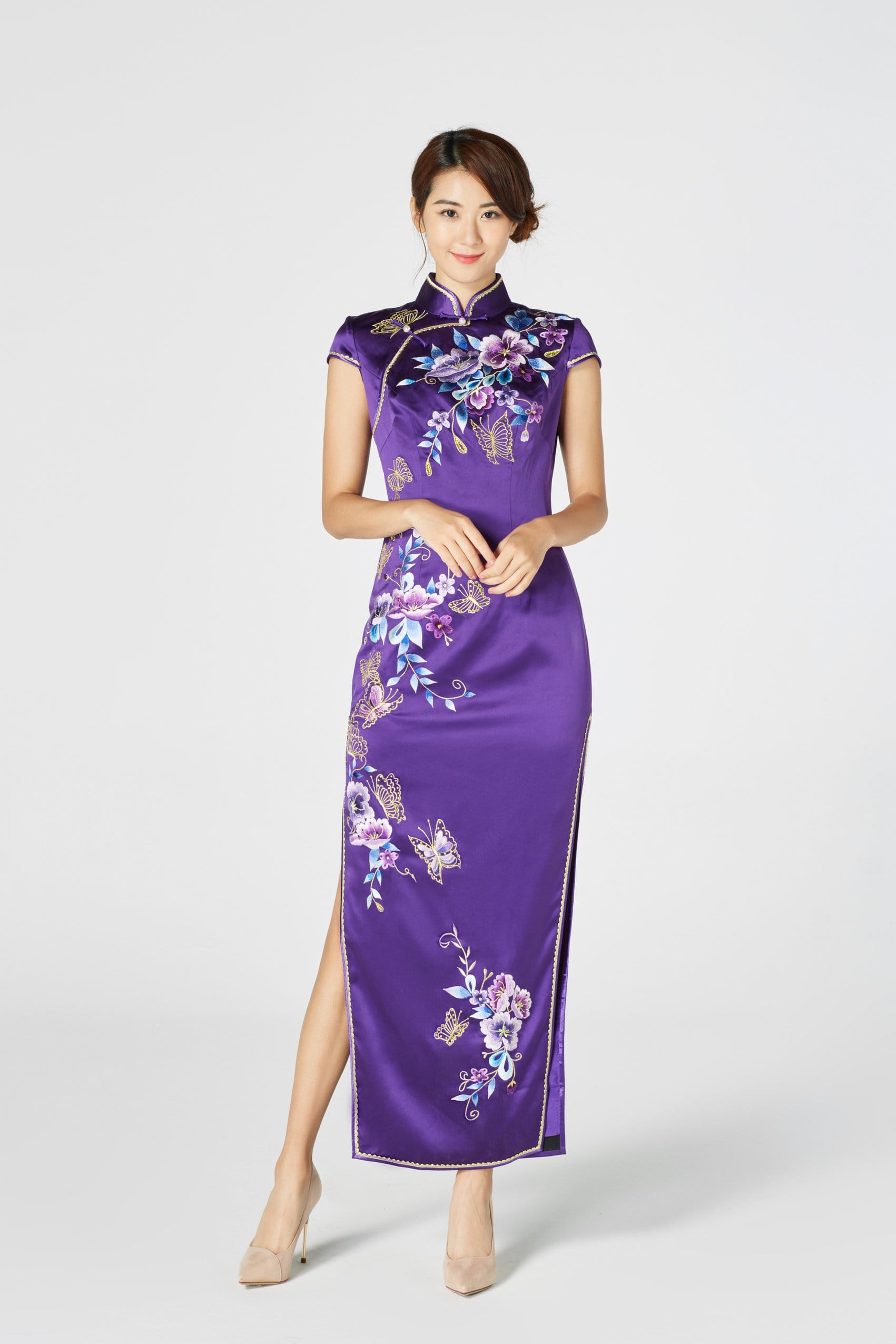
The cheongsam, also known as the qipao, is a type of body-hugging dress of Manchu origin. It is a high-necked, closefitting dress with the skirt slit partway up the side. It was known as the mandarin gown during the 1920s and 1930s, when it was modernized by Chinese socialites and upper-class women in Shanghai.
Example: A cheongsam usually has two long slits at either side of the hem for convenient movement and display of the legs.
Unlike a short skirt, the slits of cheongsam show a woman's legs when she walks.
fr: Qipao
Crinoline
noun
A crinoline is a stiff or structured petticoat designed to hold out a woman's skirt, popular at various times since the mid-19th century. Originally, crinoline was described a stiff fabric made of horsehair ("crin") and cotton or linen which was used to make underskirts and as a dress lining.
Example: A crinoline is a kind of underskirt construction that allows a skirt to be worn wide, very wide and extremely wide.
fr: crinoline
Dart
noun
Darts are a dressmaker's punctuation marks. They are a technique used for shaping garments by curving straight fabric to the body. Darts are created by stitching a long, thin pinch to a point, which is then pressed down to one side.
Example: Sew to the end of the dart, then turn your fabric around and stitch along the fold within the dart.
fr: cran
Ease
noun
In sewing and patternmaking, ease is the amount of room a garment allows the wearer beyond the measurements of their body.
Example: So with wearing ease you are able to move, sit and breathe in the garment, but if you want to add a flowy skirt or maybe a boxy fit.
fr: aisance
empire waist
adjective
Empire silhouette, Empire line, Empire waist or just Empire is a style in clothing in which the dress has a fitted bodice ending just below the bust, giving a high-waisted appearance, and a gathered skirt which is long and loosely fitting but skims the body rather than being supported by voluminous petticoats. The outline is especially flattering to pear shapes wishing to disguise the stomach area or emphasize the bust. The shape of the dress also helps to lengthen the body's appearance.
Example: An Empire Waist garment has a high cut waist seam that sits directly under the breasts (above your natural waistline). It’s flattering on so many body shapes because it doesn’t require a defined natural waist to work.
fr: taille empire
generic fiber name
adjective
A generic name can cover a range of products but must refer to the chemistry, the technologies used and the fibre properties. Following publication in the Official Journal, the name is included in the BISFA generic classification of fibres.
Example: Lyocell is the newest generic fiber approved by the Federal Trade Commission. The trade name used for this fiber is Tencel.
fr: Nom générique de la fibre
Godet
noun
A godet is an extra piece of fabric in the shape of a circular sector which is set into a garment, usually a dress or skirt. The addition of a godet causes the article of clothing in question to flare, thus adding width and volume. The most popular use of godets is in petticoats.
Example: One way of adding fullness to a particular area of your garment, for example, a hemline on a skirt or a back of a dress or even the bottom of a sleeve, is by inserting panels of fabric which are commonly known as godets.
fr: godet
Non-woven
adjective
Nonwoven fabric is a fabric-like material made from staple fibre (short) and long fibres (continuous long), bonded together by chemical, mechanical, heat or solvent treatment. The term is used in the textile manufacturing industry to denote fabrics, such as felt, which are neither woven nor knitted.
Example: Nonwovens may be a limited-life, single-use fabric or a very durable fabric. Nonwoven fabrics provide specific functions such as absorbency, liquid repellency, resilience, stretch, softness, strength, flame retardancy, washability, cushioning, filtering, bacterial barriers and sterility.
fr: non-tissé
pagoda sleeve
noun
A funnel-shaped outer sleeve turned back to expose an inner sleeve and lining. 'The pagoda sleeve can also have a formed slit or a straight slit for the under sleeve to show rather than just straight across all the time.
Example: The pagoda sleeves were trimmed with a matching fringe, but it was purpose-made, not just the dress fabric with the weft unravelled.
fr: manche pagoda
Pleat
noun
A pleat (older plait) is a type of fold formed by doubling fabric back upon itself and securing it in place.
Example: The Three pleat skirt has a pleated front and a plain back which gives a flattering fit.
fr: pli
Polonaise
noun
Skirt style in which an overskirt is pulled to the side, looped up, puffed out, and draped over an underskirt. Now used largely for evening and bridal gowns.
Example: The robe à la polonaise or polonaise is a woman's garment of the later 1770s and 1780s or a overskirts to the dress, or the Polonaise skirt, must be very long and only looped up at the sides.
fr: jupe polonaise
Princess seams
noun
"Princess line" or "princess dress" describes a woman's fitted dress or other garment cut in long panels without a horizontal join or separation at the waist.
Example: Princess seams are long rounded seams sewn into women's blouses or shirts to add shaping or a tailored fit to closely follow a woman's shape. They are sewn into the front and/or back of a shirt, and extend from the waist up to the arms.
fr: ligne princesse
Raglan
noun
A raglan sleeve is a sleeve that extends in one piece fully to the collar, leaving a diagonal seam from underarm to collarbone.
Example: A Raglan sleeve is created with a continuous piece of fabric, extending from the collar of the garment to the underarm - often found on casual clothing and sportswear, like t-shirts, sweatshirts or sports jackets.
fr: manche raglan
sportswear
noun
Sportswear is the special clothing worn for playing sports or for informal leisure activities.
Example: Sportswear or activewear is clothing, including footwear, worn for sport or physical exercise. Sport-specific clothing is worn for most sports and physical exercise, for practical, comfort or safety reasons.
fr: vêtements de sport
Tuck
noun
In sewing, a tuck is a fold or pleat in fabric that is sewn or fastened in place
Example: Tucks are folds made on fabric and sewn in place. It is made to contain the fullness of fabric or as a decorative element.
fr: repli
Watteau back
noun
A loose, full back of a woman's gown, formed by wide box pleats hanging from a high shoulder yoke and extending to the hem in an unbroken line.
Example: The back of a woman's gown in which one or more very broad folds are carried from the neck to the floor without being held in at the waist, while the front and sides of the gown are shaped to the person and have a belt or its equivalent.